
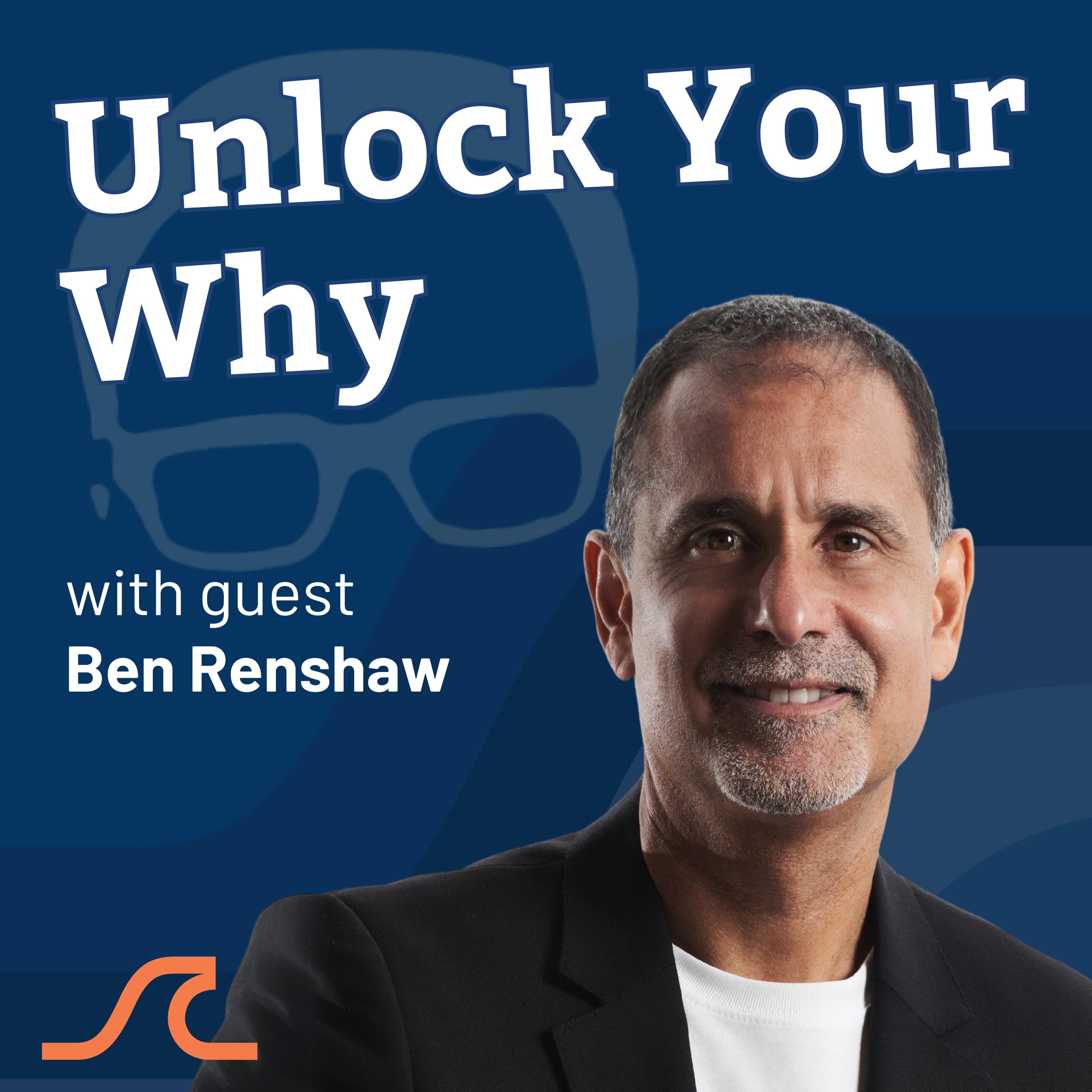
Episode 632
Ben Renshaw argues that leadership transformation begins when leaders shift from working for themselves to working for others. Drawing on two decades coaching executives at companies like IHG and Ghirardelli, he demonstrates how discovering a personal sense of purpose unlocks a fundamentally different kind of leadership. The change resembles becoming a parent: everything that was once about you suddenly becomes about them. Without that shift, leaders remain technocrats who may excel at strategy or finance but fail to connect with their teams or build anything enduring.
Renshaw shares the story of a CFO who insisted he was not a leader but a technocrat, despite being accountable for 3,500 people. Through a lifeline exercise that surfaced the key events and values of his life, the executive articulated his purpose as creating opportunity for others. Eighteen months later, he became CEO and delivered an inaugural address built around photographs from his childhood, inspiring colleagues who had never known who he really was. The transformation came not from new skills but from discovering what he cared about and making his work an expression of that.
The conversation also explores how companies scale purpose beyond the executive suite. At Ghirardelli, the leadership team defined their purpose as making life a bite better and built a talent development program that helped every people manager articulate their own why and coach their teams through the same process. The result was a culture where hourly factory workers on unionized shifts experienced their work as meaningful, not just transactional. Renshaw insists that alignment between personal and organizational purpose is not theoretical but measurable, using dashboards that track how leaders demonstrate their values in practice.
Key takeaways
- Create a personal dashboard with success criteria for how your purpose shows up in different roles, then measure red and green like any other business metric.
- Use the lifeline tool to chart significant life events, translate their impact on your values, and identify when you are at your best to articulate a personal sense of purpose.
- Leadership becomes real when you shift from working for yourself to working for others, the same profound transition that happens when you become a parent.
- Connect with teams through storytelling by focusing on the specific moments where emotion lives, not exhaustive details or abstract topics.
- Build leadership capability by developing mindset, skillset, and toolset in that order, starting with the emotional center that drives decision and action.
Guest
Ben Renshaw is a leadership coach and author based in London. He began as a classical violinist before transitioning to personal development work in the 1990s, co-founding The Happiness Project in the UK. He has advised executives at IHG, Diageo, Ghirardelli, and other global organizations, developing leadership programs centered on personal and organizational purpose. He is the author of How to Be a CEO. benrenshaw.com
In this episode
- 00:00Why discovering personal purpose transforms leadership
- 01:10From classical violinist to leadership coach
- 07:45How different cultures resist emotional authenticity
- 14:21A reluctant CFO discovers his purpose and becomes CEO
- 23:43Personal purpose must extend beyond yourself to matter
- 26:50Leadership shifts from me to you like becoming a parent
- 29:10Ghirardelli scales purpose through every level of the company
- 37:37Lower Thames Crossing builds the greenest road ever
- 40:18Infusing purpose through symbols rituals and traditions
Read the full transcript
Why discovering personal purpose transforms leadership
00:00Bill Gallagher: Have you ever had a week when you're completely slammed, but somehow nothing actually moved? Is this one of those weeks? That's not really a time problem. It's a busyness habit problem. My new book, Busy Is Broken, Do Less, Scale More, is all about growing by doing less, not more. Read or listen to a sample chapter over at busyisbroken.com. That's busyisbroken.com. It's also on Amazon and other booksellers.
00:32Bill Gallagher: Why? Why do you exist? What's the point of your life? What lights you up? Your personal why and how it impacts your role as a leader, how it affects your company and your team. That's our conversation today. Your personal why and why that matters.
00:53Bill Gallagher: Hey, everybody. Bill Gallagher, Scaling Coach, host of this super fine Scaling Up Business podcast. We bring our show to you every week with an author, a guru, an expert, someone to do with something to help you grow and scale your company, and maybe even enjoy the process, not have to work so hard, not have to suffer. Life is hard enough as it is. Let's not make it any harder. How do we make it easier to grow your business, have a big impact on the world, do something that you're really proud of? That's what our show is all about. 630 plus shows and more at scalingcoach.com or wherever you're getting this right now. So just, like, subscribe, turn on your notifications, that kind of thing so you get it every week. Anyway, you'll find all that and more at scalingcoach.com.
From classical violinist to leadership coach
01:37Bill Gallagher: Alright. I'm joined now by Ben Renshaw from London. And Ben is a leadership coach and author. He's written How to Be a CEO and a whole bunch of other books around leadership and purpose centered. He's been an advisor to lots of leaders at companies like IHG, Diageo, Ghirardelli, Heathrow, places like that. And he's going to talk to us about figuring out your personal why, connecting to the business. So welcome to show, Ben.
02:08Ben Renshaw: Hey, Bill. It's great to meet. Thank you. Really appreciate it. And yeah, just listening to you there kind of takes me back to the origins really of my own journey looking at why. I started life out with a very, very different hat on. I was a classical musician. I was actually a violinist, and I grew up at a little music school just outside London called the Yehudi Menuhin School. Yehudi Menuhin, the founder, was a real visionary and an amazing humanitarian and traveled the world playing music. He was very, very purpose led, although he didn't use that language. In fact, my father was my head master, my head teacher, so he ran the school, and I played the violin anyway, and I auditioned. I got in at the age of eight, and at that point, I didn't really question my why. So I grew up from the age of eight to 18 practicing four to six hours a day. So it's a very intensive environment.
03:18Ben Renshaw: But then as the music profession began to loom and get real, I realized this was not for me. And it was one of those challenges where because I was very talented, that was my trajectory, that was my path, but it did not light me up. It wasn't where I got my energy. It wasn't my passion. I then started to travel. I remember distinctly a moment where I'd taken my violin. I had my backpack. I went over to Europe. I was down…
03:53Bill Gallagher: There's not a lot of violinists backpacking, right? Those two things. We think of a guitar maybe, but not a violin on the road.
04:01Ben Renshaw: And I had a moment. I was down overlooking the Mediterranean, waiting for a bus, a coach to take me to my destination. In that moment, it was a real realization that there's more to life than playing the violin, and I needed to really figure out my own sense of why. That year was very pivotal for me, and then I landed up at a music college in London and within moments realized this was not for me. That was another real trigger for me of then trying to figure out, look, what do I love and where do I get my energy from and what's really meaningful for me and how do I want to spend my time? And so that was very much my inquiry at the time. I put that together and I realized there were two main things that really interested me, were people and problems. And I thought if I put the two together, I'll be happy. I set myself up as a problem spotter, and I did all my initial training in the States. I spent a lot of time in Seattle and in Connecticut and New York and trained with a private institute that specialized in a real range of personal development, leadership development, cultural work. Came back to the UK, and believe it or not, I joined forces with a partner at the time, and we created something called the Happiness Project. This was in the '90s. I can tell you, looking at studying happiness and positive psychology in the UK in the '90s, we're a country of misery. We love our mild martyrdom, our quiet desperation. If you talk about happiness or well-being or wellness, you're met with a lot of irony and cynicism.
05:58Bill Gallagher: You know, I've led a couple of workshops in the UK. And maybe the first one, but certainly an early one that I remember, I was asked to go lead a workshop. I was on a trip to London, and then I offered to do some kind of a workshop for this group there. And they were like, well, we don't really need one in London, but would you go to Canterbury? And there are some friends within this world that wanted to host, to put on a workshop in Canterbury, and they're actually from a musical background, these guys. And so I said, sure. I'll go to Canterbury. I can't recall having been there since I was a kid. And so I went and this was all about, like, purpose and unsticking your life and things like that. And there was snow in February, which grinds everything to a halt. And it took a long time. We finally arrived in Canterbury. We were supposed to be, like, 60 people. There ends up being quite a few, maybe 30 or something like that. And I'm like, alright. Here I am. I'm gonna do this workshop. I'm from California. And I start sharing about things in my life where I'm stuck and I'm, you know, I'm super, like, authentic, open, vulnerable, kind of emotive. And they just looked at me like, oh, this isn't theoretical. You want to talk about our lot? You want us to talk about things that really matter in our lives? Well, like, we're not gonna do that. They were very much like, oh, this is very nice to see you, Mr. Gallagher. And that's about as far as we're gonna go. So it was funny. It was memorable. It was a good time. They were super polite. But, like, going deep in that kind of a town and that thing, not gonna happen for me.
How different cultures resist emotional authenticity
07:45Ben Renshaw: Yeah. No. No. That resonates. I look. I get that. And I encountered, yeah, I mean, it was great training for me because all my initial work was in, it was literally encountering so much skepticism and cynicism, and it developed a really good kind of muscle memory on that for me.
08:11Bill Gallagher: It's hard in some places and some cultures to get beneath the veneer, to get real about things, right? To talk about what really matters, right?
08:20Ben Renshaw: I think in every culture. I mean, I've been very fortunate to work globally. I mean, if you're in Asia, as an example, you'll get a lot of nods and a lot of yeses. Of course, underneath, it's like, no. And then they're not going to share what they really think or feel. In my experience of California, I mean, I love the positivity.
08:41Ben Renshaw: But even then, that can lead to a bit of a veneer in terms of what is authentic, what is really going on. Again, you can get people who are very polished and very rehearsed in terms of using the language of the job and all that, but what's real? I think that for me has always been just a really interesting inquiry about what's real and what's meaningful. So I was fortunate to transition out of music and then really stumble into the world of coaching. Very fortunate that my mentor and coach was essentially the originator, the grandfather of business coaching in Europe, Graham Alexander. Very seasoned, very experienced. He was operating at a CEO level, and he played me in way before my time at that C-suite level.
09:42Ben Renshaw: The example you mentioned around IHG InterContinental Hotels Group was a good example. So he was coaching the CEO, who, again, was an incredible leader, a guy called Andy Cosslett, whose background was in branding and marketing. He worked for Cadbury in chocolate. Andy went into IHG, and at the time, they were a numbers company. And he quickly realized that actually they had guests. They had a lot of guests globally. They went on a business strategy where they went asset light. They sold off all hotels around the world, really created the franchise model with Holiday Inn, Holiday Inn Express, et cetera. I mean, in terms of scale, extraordinary. And they created a core purpose called Great Hotels Guests Love. And through conversation with Andy and the HR director, a fantastic woman, Tracy, little did I know, but it gave birth to a program called Leading with Purpose, which took people on a three-day journey through the exploration of their own sense of purpose and how did you then bring that through to your leadership and really scale with impact as a leader. I was then very fortunate to spend the next ten years developing a thousand leaders globally to lead with purpose. That really built that for me.
11:10Bill Gallagher: So did the company purpose start before the leader's purpose, or did the leader's purpose follow and connect to the company purpose at the CEO level?
11:27Ben Renshaw: In that example, it was company first. So it was a very strategic choice, number one, to go purpose, to be purpose-led, of which obviously then defining the core purpose of the organization and then really building the leadership capability to be able to bring that to life and execute it.
11:47Bill Gallagher: I think about when purpose occurred to me in my life. I had already accomplished a lot of things and I was fairly aware of my strengths, right, like the skills and abilities that I had, whether they be genetic or learned or both. And as I assessed my life at that point, so I had two kids, a wife, a house, a cat, and three businesses, and they were all kind of failing. And I'd accomplished some things. I'd grown a business already. And so I knew my strengths and I'm like, I'm a leader and I'm smart and articulate and all that. And that, it's true, those things were true. And yet somehow it was flat and I was left wanting. And I did an exercise which I've done with folks many, many, many times, right, to just ask, what's the happy ending? Like, if your life ends well, what do people say about you? What's that legacy, right? And I thought about the people I really love. I thought about my kids, and someday there would be grandkids, and there is. I have a granddaughter today. And I thought about close people I've worked with, and I imagine people gathering around. And I just wanted them to say that I was one of the good guys. I wanted them to say that I made a difference for people, that I was a contribution. And I realized, like, as I thought about my work, that that wasn't in the foreground. I was out to accomplish things, to make money, to build businesses, to have a cooler office, to be a cooler person. And I had my things. Like, my kids, my family, they were mine versus I being theirs. And that reoriented my DNA, right? And I began to shift. I started to think about how do I be a contribution to my team? How do I coach them and develop them for whatever they want and be that kind of an organization? That changed the way I worked and everything like that. And today, right, my purpose is helping leaders build a better world. Helping leaders build what they want to build, like fulfill their passion vision for something better. And it's deeply empowering, but there's like the personal purpose, right? And then there's the business purpose, and the two are totally connected, right? Because I'm not a big team. I'm myself and a handful of support, some other coaches. So that's a totally different thing. Like, reorient stuff. And I work all the time with companies on their purpose, but the two, not necessarily that leader and the business, not always integrated. And not all leaders seem to want to figure out their personal why.
A reluctant CFO discovers his purpose and becomes CEO
14:46Ben Renshaw: Look, thank you for sharing that, Bill. It's very profound, very meaningful. I appreciate that. Look, I think that from a company perspective, I've been fortunate to work consciously with purpose over the last twenty years and with organizations, and every version that you've said of what that means and looks like. So let me bring that to life with a couple of examples and stories. There was one leader I coached. He was a CFO, and he was on the succession plan as CEO for an organization who were very, very focused on purpose. As part of succession, he had his 360 feedback, and he got the results and they weren't pretty. I get wheeled in by HR. He didn't like the results. He really didn't like the look of me. But we did find some common ground. And one of my first questions to him was, what is your leadership philosophy? What are you about as a leader? He said, I'm not a leader. I'm a technocrat. Now, he was accountable for over 3,500 people globally. He already had. But for him, leadership, it was just not on his radar. He hadn't translated it. It didn't have meaning for him. But he did want to—
16:19Bill Gallagher: Which makes sense because he's a CFO, right?
16:26Ben Renshaw: He's a typical profile, very typical of a technocrat. I get it. And he was brilliant at what he did. He was highly respected in the city and with stakeholders and shareholders and investors, all of that good stuff. But he did have some interest in being CEO, and essentially the feedback that came back to him is, who are you? We don't know who you are. We don't know what you stand for. We avoid you on a Friday afternoon because you're always grumpy and moody and angry and all of this. So I said, look, why don't we, just for exploration, why don't we just look at this idea of purpose? And, similar to yourself in terms of, look, begin with the end in mind and the obituary, all of that. But what I do is I do a lifeline tool, which I'm sure many of your listeners will be familiar with.
17:16Bill Gallagher: They use lifeline all the time around YPO and EO and that kind of thing.
17:26Ben Renshaw: Yeah, absolutely. So, you know, and he said, look, this will be a conversation. Three hours later, we were still going. So for those of you not familiar with the lifeline—
17:31Ben Renshaw: It's where you charter. You go back and you really look at the major significant events and experiences of your life, number one. Number two, you translate, make meaning of those events. How do they impact you? How do they reshape you, and then in terms of your own sense of values? And then, coming out of that as well, really looking at when you're at your best, where you get your energy from, what's meaningful, what's impactful, what is the difference in the contribution that you want to make. And you kind of put that together to arrive at a sense of purpose. So anyway, three hours later, he said, you got to come back tomorrow. I came back. We did another couple of hours. And out of all of that, he defined his own sense of purpose, which was to be a creator of opportunity. As I see it, though, because he loved big change, so actually he got a lot of energy from really making an organization better, making change happen, and creating things better for others. So actually his intrinsic motivation, not that he consciously articulated that, but that was what was there for him. Then, as CFO, we then needed a spreadsheet. Then what we did was we took the creator of opportunity and really drilled into what would success look like. How would you know that you are being a creator of opportunity as CFO, as a leader, as an exec member, as a board member in the community, with shareholders, and then personalization in terms of family and as a father and a partner and in the community, et cetera. And literally, he created his own dashboard of his success criteria. We had red and green in terms of the ability to measure and where he was. And eighteen months later, he was actually successful. This became a framework out of that that really drove his leadership, created a narrative out of that, a story for him to bring that to life. And I will always remember, eventually he succeeded and he had to give his inaugural address as CEO. And of course, everybody, the expectation, as CFO to CEO, you're going to just talk about the numbers, you're going to talk about performance, how everything could be more and bigger and better. I remember being in his office and him giving me the draft of his address, which obviously was like a spreadsheet. I asked him, what is success for you from this address? He said, well, I want people to be inspired. So I took a deep breath and I said, that ain't going to do it. That's not going to cut it. And I suggested, why don't you just tell your story? Because actually, that would really inspire. Eventually, that's what he did. Literally, he just put up photographs from his life. I remember the photograph. His parents owned a gas station, and there was a picture of him pumping gas as a child at aged eight. And he could talk about the importance of service and being in the front line. He was in the service industry. And he could talk about being out the back and counting the money as a child and the impact of that. And then later, he put a photo of his family and children, and one of his daughters had bright red hair. He could talk about diversity and celebrating difference. And then his final photo, of course, was him with his fast cars, and he could talk about winning and speed. And of course, the feedback from colleagues was they were blown away.
21:26Bill Gallagher: Yeah. Let me pause you and tease out a couple of things I hear there that are interesting for our listener viewers. One of them is the power of storytelling. Right? So you start with a lifeline. That's telling your story and a particular focus on the highs and lows of your life and getting to the feeling of it. Right? And it's those areas where the meat is. Right? And then an obituary or a eulogy is a forward-looking story. So I imagine the future, my future story, and I'm telling that story. And again, I'm focused on the little bit, not the all of it, but like the little places where they meet. And then you talk about telling the story to the team. And storytelling is really powerful because we touch on those emotional centers and the moments that are powerful. But if we don't have any facts or figures, we're talking about something, we're not really sharing it. If there's not like, we can't create a picture. And yet, if we get too bogged down in too many details that are extraneous, then we also lose. Like, if I'm not talking about the details where the emotion, where the feeling lives, then I, and people get bored pretty fast. So you just need a little bit where that's actually centered. Right? So you talk about the moment of crisis or insight or those kinds of things. And that creates the powerful thing. So I'm taking my daughter to work or to school on my way to work, and then I have this thought and I realize my life in what I thought it was. Right? Now, boom, I've got something. But if I tell you, well, and then we got ice cream and then I got a coffee and then I did this, and I'm like, none of that stuff matters. So there's some balance there of going right to the things that you really care about. That's the thing I heard first, the storytelling and focusing on the… The other thing I heard in all of that is that there are things that we care about. Right? Like, I love outdoors and I love adventure, and I love sailing and surfing and skiing and things like that. But if I just talk to you endlessly about that, there's not, there's not fulfillment there. Right? I might enjoy it for myself. But when I give it away, if I care about creativity or hospitality or whatever, and then I'm being a contribution of that thing that I love to, everyone should have access to that if they want it. That I've actually got something. The purpose starts internal, but until you get it outside, bigger than yourself, it's like just hedonism.
Personal purpose must extend beyond yourself to matter
24:10Ben Renshaw: I think, look, picking up on that, Bill, a couple of points. Number one, in terms of the storytelling. For me, business is relationship. The ability to connect, to me, is absolutely one of the most important ingredients of leadership. Without a doubt, whenever I ask anybody who's their most admired leader and why, it's very, very rare that people will come back and say, oh, because of their strategic thinking or because of their commercial acumen or because they could do the numbers. I think they're kind of, look, yeah, particularly at an exec level, they're givens in terms of that level of capability. But the differentiator, what absolutely makes the difference is that moment to connect. That goes both ways. That is obviously through sharing a story, but it's also creating the environment and the conditions where others can really connect with themselves and then bring that through. I loved your introduction about what you do and scaling business. For me, the ability to connect, if you want to scale that, and for me, and particularly as you say from an emotional perspective, that is key. People, we live in an experienced economy. That's what people want. That's what they look for. And then I think the second distinction that you made in terms of looking at purpose and the translation of that, yeah, it's not about me. It is about you. Again, for me, from a leadership perspective, that's probably the most profound shift that leaders go on. It's a bit like being a parent. Those that, and I say this very mindfully and respectfully because I'm very mindful that not everybody's able to be parents or want to be parents, and I totally get that. But certainly, my only experience…
26:22Ben Renshaw: My life was about me until I had kids, and then everything is about my kids. Everything I do is about my kids. And I think as a leader, it's like until you're actually in a role of leadership, it's all about you. And then once you're in that role, it's all about others. And I think that's a very, very profound shift to make.
26:43Bill Gallagher: You know what? That's a really, really useful thing. You can't build anything really significant on your own. Even today, the highest sort of revenue to employee companies in the technology world, there's still some people. Right? Like, and as they grow, then they add all the kinds of people and contributors and teams and things like that. Like, there's gonna be some people. You can't build a multi-billion dollar global enterprise with two other guys. Like, there's gonna be some folks involved. And so if you wanna do anything big, like, you've gotta get good at being with people. Right? And then the first person to get good with is the guy in the mirror, the guy or gal in the mirror. Right? If you're all a mess and can't be with yourself, it's pretty hard to connect with other human beings. Right? But when you're clear who you are for you and who you are for the world, it starts to get a lot easier to have the capacity to listen, to share, to inspire, and to pull that out of other people to create opportunities for others to step into something bigger.
Leadership shifts from me to you like becoming a parent
27:55Ben Renshaw: Yeah. I agree. And then the beauty of that for me is that is all developable. So kind of wherever you are, you're talking about capability. And I break down capability in three simple ways, which is mindset, skillset, and toolset. Mindset, skillset, and toolset. When you're looking at that, obviously I'm applying this to purpose now, but what is the mindset to lead with purpose? What are the skills? What are the behaviors to demonstrate to lead with purpose? And what are the tools, the enablers? What's what's gonna really help you sustain that and bring that to life? And that, as an example, is all the work I do.
28:38Bill Gallagher: Mhmm. Yeah. So starting with that emotional center. Right? We've talked before about Simon Sinek's work and others and Aubrey Daniels and thinking about the place where all the decision and action starts with something that you care about, that you feel strongly about, that's enduring in your life. Right? Getting in touch with that, there's a lot of power. Why don't we share another story? Why don't you talk about the chocolate business? Because I think everybody loves chocolate.
Ghirardelli scales purpose through every level of the company
29:10Ben Renshaw: Yeah. I've been very fortunate to work with Ghirardelli, so the chocolate brand in San Francisco. The former CEO there was an amazing guy called Joel, who's actually from Ireland. He's from the UK. He's now back over here as CEO of Lindt UK. But I was fortunate to work with him and the management leadership team for about a seven year period, and he was very, very purpose led. And he really created a whole framework for the organization based on purpose. They defined their purpose to make life a bite better, which is I love that. Good for chocolate.
30:00Bill Gallagher: But you really hear like a little joy, like a little pleasure, a little bit of joy and pleasure in a moment. Right? Like a bite better.
30:11Ben Renshaw: Absolutely. And I think as you said at outset, again, life's hard enough. Genuinely, to be able to have just a moment, a moment of joy and pleasure is a cool thing, and also to be able to give that to others and share that with others. I think that usually when you're experiencing a moment of joy, it's very rare that you just want to keep that for yourself. You want to share that. If you're having a hot chocolate fudge sundae, that is definitely something you want to share.
30:56Ben Renshaw: What Joel and the team did, they really developed their whole game plan is what they called it on the back of that, and that was to rescale a business but through purpose. There were three strategic pillars with that. One was being purpose led, one was continuous improvement, and another was sustainable growth. Out of that, they really derived all the projects and the initiatives for the company and they got everybody clear and aligned around all of that. Joel was so committed to building leadership and management capability. Then we created a program called Talent Manager Excellence, which, again, was really enabling every people manager in the business, number one, to have an experience of, well, what's their why? What's their own sense of purpose? But then how to translate that and how to coach and help others to have that sense of purpose and then in their teams and then in the factory. And we went right out on the factory floor. And you're in a unionized environment. You've got workers on hourly shifts, etcetera. So this permeated the whole system.
32:11Ben Renshaw: For me, I think what it really gives, it just gives another dimension to this notion of work. Therefore, you're really helping people infuse those precious, precious hours that they will commit and give to an organization. You're actually providing the conditions in the environment which is meaningful for them and where they can get their energy from. A lot was invested in terms of the community, in terms of colleagues and working together, and then obviously for consumers and customers.
32:44Bill Gallagher: It's funny as you think about that, I think about taking a bit of pleasure and then centering it in purpose, sharing it out in some way. And I remember when I had that insight, when I sort of first discovered or noticed or created, I guess you could say created my life purpose. Then I had a coach at the time who's now head of talent development at the Gallup organization. And a guy by the name of Dean Jones who's been a past guest a couple times on the show here. You can go look for past shows with Dean Jones. So anyway, so Dean's like, okay, well, we have to do some work around this purpose, develop a muscle around it. You need a project in this area. So he's like, it could be about anything. And I would go on to bring lots of projects around my business. But the first project, because he said you could do anything, I was like, well, my main sort of interest and hobby at the time was flying airplanes. And so I'm like, it is the most selfish, expensive, time consuming thing. I have young kids, multiple businesses, and I like to fly airplanes. Right? So expensive and time consuming away from both business and family. So I'm like, how do I create a project where I share that in some way, where it'd be a contribution. Right? I said I wanna make a difference for people. So I'm like, oh, what if I just take kids flying? Right? So there already existed a project like that. So I just co-opted it and brought it to our town, which didn't have it in Oakland, California. And I'm like, we're gonna bring this project to take kids flying and I'm gonna just give away my joy of flying. Right? And I so I started with a little bit. I encouraged some other pilots to join and after a while, we took over a thousand kids flying. And now my wife was waking me up on the weekend. She's like, hey, get up. You gotta go. You got kids for you today. Right? And then you take a group of eight year olds in a plane and they're just ecstatic. Like, they don't try to act cool or whatever. They're just like, yeah, this is the most amazing thing ever. And you realize you've given somebody a sense of
35:02Bill Gallagher: Like joy and empowerment and experience that they didn't have, right? And now suddenly then, I was on the TV news and that kind of thing hundreds of times. And now the copier guy in my office and other people are like, I'm that guy who takes kids flying, not the CEO of this company. And people start relating to me as somebody who's a contribution to others, not just making money, right? And now I made more money as a result of that shift. But who I was and why I did it was combined. And, you know, I think about that chocolate that you said and like the joy and the sharing of the chocolate. Think about today, there are things you love. Maybe it's chocolate. Maybe it's art. I like to go sailing, right? And I like to do this wing foil surfing. But when I bring somehow, like I take CEOs sailing who visit San Francisco from around the world, then we talk about their life and their business and their family. Like, now I'm integrating a pleasurable thing with a contributory thing and everybody's, there's something that's completely different in those situations, right?
36:16Ben Renshaw: Absolutely, Bill. And, you know, again, that's where I feel incredibly fortunate in what I do because my work is a complete expression of my own sense of purpose. The way that I articulate my sense of personal purpose is about to discover truth, like what is real. That's always just been my absolute north star forever, and whether it's individuals, teams, organizations. One quick example which is very topical here in the UK at the moment, so I work with a construction program which is to rebuild a tunnel and bridges and a motorway, which is a real, it's our gateway out to Europe. So it's called the Dartford Tunnel. This program is called Lower Thames Crossing. It's a £10 billion program. It's government. The director is very, very purpose led. I've been fortunate to work with him for many years. So together with the team, it really helped them come up with their own sense of purpose as a project because, you know, when you're in construction, everything's about on time, on budget.
37:29Bill Gallagher: Which I get. But you're like building something in the world that people are for, you're doing something, right?
37:35Ben Renshaw: So through a whole iterative process, they came up with how they articulate their purpose, which is to build a better world. It became translated through four Cs of carbon, construction, culture, community. The aspiration is to build the greenest road ever built. Even before it's built, they've already impacted and influenced the building industry where they've raised the standards on carbon, etcetera, which is already a game changer. What they're now looking at, so our government actually this week, so there's potentially going to be an announcement because nothing happens fast. They've been in planning for eleven years, eleven years for this road. $1.2 billion has been spent just on planning because of regulation, etcetera. There's a lot of red tape to cut through. I just share that as an example because that's impacted then everybody that's been part of that program. They've all had an opportunity to self discover their own sense of purpose, make meaning of that, translate it in terms of what they do, but also in terms of their lives as well. And then they've already impacted the supply chain in terms of partnering with major, major construction partners who, again, are needing to adopt these ideas and principles because they've translated that in terms of their governance as well. And then that got written up in a sustainability report that went to the government, and again, all these measures and factors on that. So it's just an amazing thing that I think that, to me, my experience is your work can absolutely be a very, very tangible expression of your own sense of purpose, your own why. And for me, the opportunity and ultimately the gift and the blessing to align and coordinate that is just an amazing thing.
Lower Thames Crossing builds the greenest road ever
39:32Bill Gallagher: We work with companies once they've articulated their purpose and values to start to infuse them. And we have about seven different things that we frequently talk about that are actually pretty ancient. But like talking about them inside and outside the company on a regular basis, reciting them daily, wearing them on your clothing, your hats, your whatever, displaying them on your trucks, posting them at the entries and around your businesses, right? Creating rewards and penalties for them, a whole range of things like that. But sometimes companies get blasted for just creating values and sticking them on a website and on a wall somewhere and then not doing it. Why don't you talk to us about Steven at Eden and the experience there?
Infusing purpose through symbols rituals and traditions
40:18Ben Renshaw: Yeah. So, again, look, Steve, he was a remarkable character. Believe it or not, he was another CFO who became a CEO. In fact, his origins were in internal audit. He had a pretty miserable existence. I remember he attended my program Leading with Purpose, and he sat there for three days with his arms crossed, very, very cynical, just very disengaged. But he was curious and just knew there was something about him and I tracked him. I kept in touch in about five years and that was actually in the Middle East. He was in Dubai at the time. He came back to the UK and I started coaching and working with him. And we then went on this journey where he created his sense of purpose, which he articulated was to make big things happen. So he loved big stuff. It's where he got his energy from. And he was very disruptive, and the organization he was in, it was not a good fit. And he needed to do his own thing, and this was a big, so he took a massive risk, and he resigned from this organization. He had the golden handcuffs. Nobody resigned from this place, but he was really following his sense of purpose there. And he actually went on, he then went to Thailand, went on a retreat. He really got into meditation, all this stuff that you would never ever have predicted. And then landed up, this opportunity came his way to take over another hospitality brand. And we then started a journey to look at that sense of purpose as a company. And ultimately, what they arrived at was the way they articulated the purpose was soulful hospitality. So this was all about really, really connecting with your soul and having experience. Then their values were very much about curiosity and care and wonderment and community. I remember again of a really striking moment because as you said, leadership is very symbolic. So everything you described there for me in terms of visuals, for me, is symbolism. We need reminders. Can we just forget? Their internal seminars were called Soul Fest. They were like festivals. It was an absolute celebration of the brand and the team and the whole experience. And I remember on one occasion, Steven, and they were modeling it on Woodstock. Everybody had to come in dressed in costume, in the Woodstock Festival, and he was dressed in this leather and all of that. Having gone from this very, very straight internal audit CFO to this real entrepreneurial spirit of soulful hospitality, that memory will always stick with me. Then you're then creating the conditions for the next generation. I mean, I was so touched when you talked about flying for kids. For me, my massive part of my why is next generation. And I just think I put myself in their shoes today in the world they're in and all the challenges and the complexity and how do you arrive at your own sense of identity and who you are and what does that mean with everything going on? It's very, very challenging. So I think, again, for me, organizations have a very, very clear responsibility to really help next generations find out who they are and then really bring that through in terms of their work and their lives and relationships.
44:21Bill Gallagher: You know, all the different, like, religions and cultures of the world have some variation on
44:27Bill Gallagher: Do unto others, and you practice that, repair the world, or things like that that are expressed in different ways. And I don't know all of them. I'm sure there's one in almost every place, right? But then, what do you—so we get at this purpose, which is an emotional center of something, something we feel strongly about. And when you feel strongly about it, the decisions are clear and action is obvious and natural. But then if you want to center the purpose, and then to an extension things like the values, way that you operate in the organization, you have to create these rich traditions. And around businesses, sometimes they're really obvious. You think of cult-like companies like Disney or Apple or—I don't know where you are—there's ones where there's like an intentional cult built around something, not the good kind of cult, right, not the bad cult where you do that. But then, so what are those touch points? They involve regular rituals and traditions and sayings. And if you look at every, you know, whatever—if you're of a Hindu or a Muslim or a Jewish or a Christian background, you have holidays, you have tokens, you have symbols, you have saying, you have foods that are regularly occurring. And these are the places where we bring the teachings forward, like, you know, there's a release from slavery and a redemption and, like, there's these things that we celebrate, memorialize, and we teach the kids. And there's different ways of—but we need the same thing in our companies, right? Not about a deity, but about the things we care about and the way that we operate and what we adhere to. Right? And there's something like, once you've got your purpose, how do we use it is like—that's a subject for another show, and it's a good place to wrap it.
46:20Bill Gallagher: Listen, if you want to know more about Ben and his work, it's pretty easy to find him. Benrenshaw.com is the website. Benrenshaw.com. Ben, thank you so much for coming on and sharing a little bit of your world and some of your stories of your clients and stuff with us today.
46:35Ben Renshaw: Been a real pleasure. Yeah, it's been a real pleasure. I'm very grateful. Thank you.
46:40Bill Gallagher: Thank you all for watching, for listening. Shout out to my friend and mentor, Verne Harnish, created the whole Scaling Up framework that is at the center of our work with helping companies grow. There's 630 and more shows at scalingcoach.com. We also do a monthly workshop in the basics of Scaling Up work, so you'll find all that and more at scalingcoach.com. Like, subscribe wherever you are right now. And then a big shout out and thanks to the folks at Storion, Christelle, Seth, and Cameron who get our show ready and produced each and every week and out the door. Thanks everyone for watching, for listening. Until next time, keep scaling.
47:21Bill Gallagher: Thanks for listening today. One last thing, if anything in this episode hit home, my book digs into it further. Busy Is Broken. Do Less, Scale More. It's all about how to stop drowning in work and build a business and a team that scales without you. Available right now with content samples at busyisbroken.com. Go grab it. Be less busy.
Bill Gallagher coaches CEOs and leadership teams on the Scaling Up framework. If something in this episode landed close to home, the free 20-question diagnostic is a good place to start.