
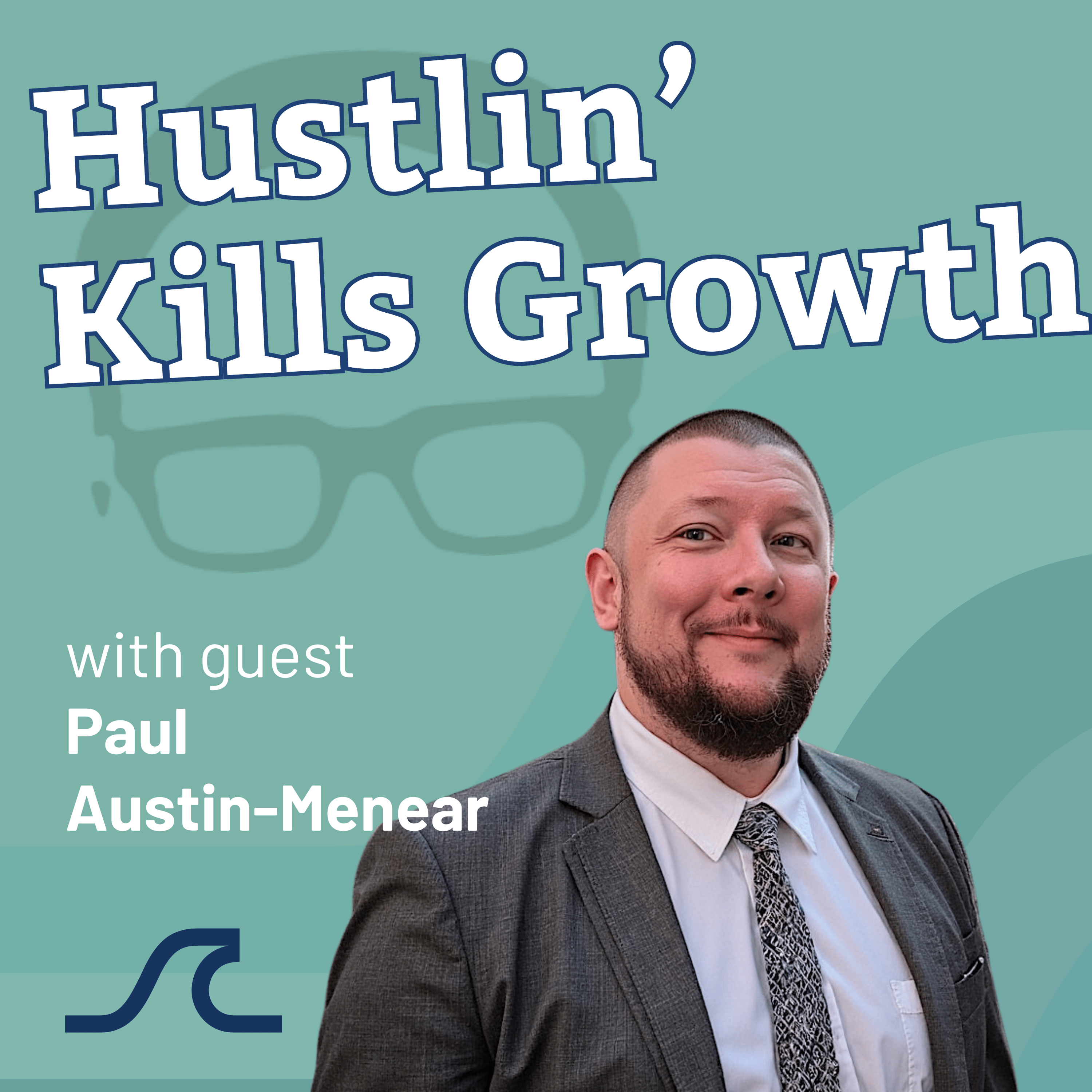
Episode 658
Paul Austin-Menear argues that relentless hustle masks operational problems and burns out the exact people who keep businesses running. He points to rising sick days and declining performance as early warnings that grinding harder has become a drag on growth. The conversation turns on when effort stops being productive and starts hiding the fact that you need better systems, clearer boundaries, and smarter processes.
Paul shares stories from his time at Nanoleaf, where he had to disable weekend email access for one overachiever to force real rest. He also walks through a vertical farming client who saved money by abandoning their original build-on-site plan after actually talking to customers. The thread connecting these examples is that sustainable scaling requires designing for resilience, not heroics.
Bill and Paul explore practical fixes: turning off email on weekends, simplifying redundant workflows, launching products in unsexy MVP steps, and creating a Scalable Feedback Engine to ensure customer insights reach the people who can act on them. The episode makes the case that protecting downtime and acting on feedback quickly are competitive advantages, not luxuries.
Key takeaways
- Rising sick days and declining performance are signals that hustle culture is damaging your team's capacity and costing you business.
- Protect downtime by turning off work communication on weekends—rest directly improves on-time performance.
- Start new products or markets with the unsexy MVP approach: ship small, prove demand, then invest in scale.
- Build a Scalable Feedback Engine with an internal champion who collects customer insights, grades them, and pushes them to the people who can make changes.
- Incentivize innovation by letting your team share in the upside of improvements they help create.
Guest
Paul Austin-Menear is founder of Six Catalysts, a Toronto advisory helping founders scale with less burnout. He formerly led marketing and operations at Nanoleaf, a consumer IoT company, and hosts The Journey, a publication and podcast on sustainable scaling. 6catalysts.ca
In this episode
- 00:00When hustle stops helping and starts hiding problems
- 02:45Sick days and absences signal burnout is costing business
- 09:50Forcing overachievers offline on weekends improved performance
- 14:03Why Paul built The Journey for accidental entrepreneurs
- 18:11Vertical farming client pivoted to shipping containers after customer feedback
- 27:30How 2D barcodes can cut shrink and recall costs
- 33:31Customer feedback sits in folders instead of driving innovation
- 39:12The Scalable Feedback Engine: champion, insights, and stakeholder action
- 40:41Unsexy go-to-market beats big launches for capital efficiency
Read the full transcript
When hustle stops helping and starts hiding problems
00:00Bill Gallagher: Have you ever had a week when you're completely slammed, but somehow nothing actually moved? Is this one of those weeks? That's not really a time problem. It's a busyness habit problem. My new book, Busy Is Broken: Do Less, Scale More, is all about growing by doing less, not more. Read or listen to a sample chapter over at busyisbroken.com. That's busyisbroken.com. It's also on Amazon and other booksellers.
00:55Bill Gallagher: Well, at some point, hustle stops helping. At some point, hustle stops helping, and it starts actually hiding problems. Paul Austin-Menear shows founders how to trade their adrenaline for systems and create a kind of growth that compounds without burning people out.
01:15Bill Gallagher: Hey, everybody. I'm Bill Gallagher, Scaling Coach, host of this super excellent Scaling Up Business podcast show. We come to you every week, and we try to help you grow your business. Hopefully, hear something, a story, an idea that helps you see yourself, your business in a new way, gives you an idea to move forward to up your game. So come here every week. You'll find 650 plus episodes wherever you're getting this. And if you go to our own website, you can find out about our workshops and our coaching programs, things like that. That's all scalingcoach.com. So that's where you find the rest of it. Otherwise, like, subscribe where you are, turn other people onto it, share the love, and everything's much better.
01:58Bill Gallagher: Alright. Alright. So my guest today, Paul Austin-Menear. Did I say that right?
02:03Paul Austin-Menear: Sure did. And kudos to you. Most people kind of butcher the first half of the second part of the name, so good on you, man. I usually check beforehand, but we were talking about other things, and I just forgot.
02:18Bill Gallagher: I'm talking to Paul today. So Paul is founder of a company called Six Callas. It's a Toronto based advisory that helps founders scale with a little sanity. He's also writer, host of The Journey. It's a publication, a podcast focused on more sustainable kinds of scaling. He's a former leader at a company called Nanoleaf and helped shift things there, and he does some work as a fractional exec consultant helping direct to consumer product kinds of companies install systems. Right? Create things that are sustainable that actually work, that work more than just your raw energy and hustle. Paul, welcome to the show.
Sick days and absences signal burnout is costing business
02:59Paul Austin-Menear: Great to be here, Bill. Thanks so much for having me on.
03:03Bill Gallagher: So here's my opening question for you. What's the first moment that you noticed that hustle was maybe a problem, that hustle creates noise that masks problems? Did you notice it in yourself and someone around you? Talk to me about the first time you noticed hustle was a problem.
03:19Paul Austin-Menear: Yeah. All of the above. I would say as a leader, one of the clear signs that you can pick up on that hustle's becoming a problem is when your people who have been hustling their butts off for you are sick more often. More sick days, more absences, or even when you're working with them, they're just not at their best, and you can kind of tell. Right? Even the most nose to the grindstone type individuals ultimately eventually need rest and need a break. And I'm also one of those people. I've been in loops where I've just been go, go, go, go, go, sixty, seventy, eighty, ninety hours a week, and it catches up with you and you just kind of fall apart.
04:02Paul Austin-Menear: And one of the things that I kind of came to eventually, this is probably about twelve, thirteen years ago now at this point, I was working with a marketing agency in Ottawa, Nation's Capital up here in Canada. And it was a small team that I was working with. There were probably 10 of us or so. And there were two designers who had been just hustling. Like, they'd been giving it. And one of them had a repetitive stress injury. It's kind of come up, and she was out. So she had a couple days off work, went to the doctor, wasn't working, and the impact on the team was felt kind of immediately. Right? And that ended up costing us a bit of business because the client was unhappy and we missed the deadline because that one person in the two person kind of little mini group within the team was out of commission.
04:52Paul Austin-Menear: So a lot of the time we tend to think, hey, let's not kind of overload on salary here. We'll just kind of push and we'll grind and we'll hustle through it and whatnot. But what happens at the other side of that when things break down and you lose business because you didn't invest in resilience and capacity? That's kind of the question that I struggled with back then, and it's been a bit of a recurring theme. So it's something that's come up quite a bit over the years with me.
05:19Bill Gallagher: You know, it's interesting in our cultures. Cultures to varying degrees have to more or less hustle built into them. Right? We think about some of the European cultures are better about taking their vacations and stopping work for dinner and that kind of thing. Some of them are better than others. Even some fairly hardworking ones, like Germans work very intensely, speaking broadly. Right? Not every German. Right? Just like not every Spaniard takes a siesta. So there are but there are cultural norms. Right? So they work really hard, but then they take a vacation, and they're pretty serious about it. Right? United States in particular, Canada, still it's a little less degree, I think. We will tend to have some of that early Puritan work ethic, like an obsession with hard work, and we're just lazy if we're not working hard. And but then that creates problems. In Japan, right, they had this thing where I have to work obsessively, and they had young people dying on the job in recent years just out of exhaustion. So some places happen in a bad way, and other people know that too much hustle is a problem. Like, we need to take a break.
06:42Paul Austin-Menear: Yeah. And the rush to get to the finish line, which very few of us know what the finish line is when we're rushing towards it. Right? That rush to get to the finish line is so all consuming that we often get a bit of a reduced view on, you know, this is a part of our life. So, yeah, you absolutely have to work hard to be successful. You have to have goals. You have to be ambitious. You've gotta keep your eye on the ball. But when you start going too hard, things fall apart and things break down. And you're gonna find eventually that that kind of hustle culture is actually a bit of a barrier to reaching your goals, the things that you wanna get done, the objectives you wanna meet, your vision for your life.
07:25Paul Austin-Menear: I've always kind of felt that it's more important to pay attention to steps in the middle than it is the beginning or the end. You know, it's more important to focus on the journey. That's kind of why my podcast and newsletter is called what it is. Because if you don't really appreciate what's happening in the moment, then when you get to the finish line, to really kind of look back on it and say, wow, you know, that was worth it. It's something that I kind of encourage all of my clients to think about broadly.
07:52Bill Gallagher: You know, let me underscore something before we move on. We're going to talk about the journey in just a moment, but the finish line. Right? Let me just get to the finish line. Let me get over the finish line. The finish line in life is death. Maybe a slight finish line before that is retirement. In business, the finish line is when you sell and exit the company, and those are not necessarily the same thing. Right? I could sell the company to support for three years. The real finish line is three years after the sale when I finally exit, or two, or whatever it is in your case. So your finish line is not the launch of the product. It's not the rebrand. It's not the launch of the rocket, like, whatever. That's just an end of an event. And then Monday comes and you do another thing, and you get on to the next launch and the next product and the revision and the next trade show and the whatever. It's ongoing. So if you're so obsessed with, like, burning yourself out for the launch or the whatever it is, right, just remember there's something else after that. Right? Like, until you sell it, retire, and die.
09:11Paul Austin-Menear: Yep. And I find particularly with young founders, you know, people who are in their late twenties, early thirties, you know, they've got a business that really is taking off and it's going. They're not thinking about that finish line like you're just talking about. And, you know, I also kind of think of it that way when you're the owner, the equity holder in the business. They're thinking like, well, the finish line is down there somewhere. I just need to run right now for the sake of running because that's what everyone else is doing. That's not always the way to get where you want to go. Right? Like, owning a business, starting, building, running, and exiting is more of a marathon than it is a sprint. Right? So you've got to be prepared for that.
Forcing overachievers offline on weekends improved performance
09:50Bill Gallagher: Yeah. You know, a past guest of the show and a good friend is a guy by the name of Warren Rustand. And, you know, Warren played for the Golden State Warriors. Warren served in the White House. Warren led multiple multibillion dollar companies. Warren's had a big life, big career. Warren is the first advocate for resting, taking time off, exercise, take time for your family, for your relationship. You know, he's a big advocate for all these kind—you can't go 24. You have moments of peak performance, then you have to stop. Then you have to eat. Then you have to reflect. Then you have to, you know, go home. He works an intense schedule. He gets up very early in the morning, but he also goes to bed early. Right? Like, you can't burn the candle at both ends, as they say, and have that.
10:41Paul Austin-Menear: And one of the things that was actually my wife that kind of gave me this advice, oh, six, seven years ago. She said to me, like, you know, you feel a little bit squirrely when you're taking time off. And, you know, like, I catch you kind of checking your phone, looking at the emails and stuff coming in, whatever. I said, yeah, yeah, that's me. And she said, well, why? And I said, well, I just, you know, I want to get things done. I want to move. I want to accomplish things. Right? And she said to me, but, you know, you need to realize that your off time is also a part of your on time, because your off time allows you to be better during your on time. And, you know, six, seven years ago, one of the wisest things she said to me, and I try to live by that a little bit more these days. And I think we all could kind of do that a little bit better. So, you know, one of the things that I did in—
11:34Bill Gallagher: Partwise, whether it's a husband or a wife, listen to your partner. They are looking at you and your life outside of your skin, and it's good because they're really committed to your winning.
11:47Paul Austin-Menear: Yeah. Yeah. It absolutely is. One of the first things that I did when I was at Nanoleaf running a kind of a marketing subgroup, and I noticed this trend kind of taking hold, was I said to the people who are kind of working with me, you know, when you are off on the weekends and, you know, not at a trade show or something, your email is off. You know, your team should be off. Everything should be off. Like, I don't want to hear from you until Monday morning. And, you know, if you've got something really, really critical that's broken and on fire like that moment, sure, take care of it. But it's got to be like a five alarm kind of thing. Like, there's business peril here. So I kind of implemented that rule and, you know, reinforced that with people over time. And what I found with that team was that, you know, we talked a little bit earlier about kind of the absences and people getting sick and burnt out and whatever. Like, that went down pretty dramatically. There was one guy, and loved him, great guy, but I actually had to turn off access to his email over the weekend to make him, like, play ball. And eventually he caught on and things got better.
12:57Bill Gallagher: Like, why my email doesn't work? Yeah. Oh, I'm sorry. You're not allowed. Well, what's the journey and why you created the journey and what you do there? This is your writing and your podcast. Share a little bit about that.
13:14Paul Austin-Menear: Yeah. You know, I'm sure everybody who's listening to this is familiar with that Simon Sinek talk about start with why. I'm a big believer in that. Right? Like, unless you know why you're doing something, you can't really excel. So for me, you know, kind of I thought about that a lot about a year ago when I was kind of preparing for this transition into being an advisor and a consultant, kind of working for myself. And I thought, you know, what would make for better communities? What would make for more resilient, happier, more kind of fruitful communities around us? And, you know, the answer for me is kind of always been an ecosystem of strong small businesses. And I feel like people who are getting into business, I kind of think of them as accidental entrepreneurs. You know, they might buy up a business. They might start something as a side hustle and kind of get going, but they don't really have any guidance. You know, they're not making enough money to hire a mentor or a coach or an advisor or be a part of a mastermind or a program or something like that. So I said, okay, well, why don't I build as a part of my model something that is educational for that accidental entrepreneur who's just starting it? Or people who have really thought about entrepreneurship and starting a business, but they haven't taken the leap because they just don't feel comfortable and knowledgeable enough about what it takes to be an entrepreneur, to run a business. So I built that for those people ultimately because I believe that more small businesses in communities makes those communities better places to be, to live, to work, to love, all of that.
Why Paul built The Journey for accidental entrepreneurs
14:58Bill Gallagher: My experience, there's a couple reasons people go into business. One is they have an idea for something, and they see a problem and a solution. They're inspired by some new possibility for the future, and they just have to go build it because nobody else has got it or going to do it. So they're going to go work on that problem. And they become entrepreneurs kind of by accident without having thought of it in pursuit of a problem. I think that's actually really powerful.
15:25Bill Gallagher: Reason for doing something, more focused on the problem. A secondary thing would be focused on their solution, which is very much secondary, because if you're more interested in the problem than you are your own product or service, your solution, then you will be flexible when it turns out your initial idea doesn't work. So keep at it, that kind of thing. If you are fixated on your solution as the answer, you may get disappointed when in fact it needs work to work, and it's not going to work as originally conceived, which is almost certain, right? Almost, but not entirely certain that it will not work the way you expected it to. It will need changes to design, et cetera.
16:13Bill Gallagher: The other one is they just can't help themselves. They go and create businesses and money-making opportunities, you know, for whatever. They just have to keep making things. Like, they are compelled to do it. It's like a, you could call it an affliction and addiction. Like, they go and create businesses. They see opportunities, and they're seizing them all over. It's less of a focus on any one thing than just creating business and stuff in general. And those people probably need more than anything else to learn self-control, self-awareness, learn to say no to their ideas, and get better at filtering out opportunity.
17:00Paul Austin-Menear: Yeah. When you're an innovation-driven kind of person entrepreneur, you know, you want to solve that problem. There's a huge risk that you can't step outside of your own brain and outside of your perceived solution being the best one, as you say. And I've seen, you know, I've seen that problem just absolutely sideswipe literally dozens of entrepreneurs because they can't really bend around the idea that maybe there's a different solution that's necessary.
17:33Paul Austin-Menear: I was working with a client earlier this year, actually, on that kind of topic, and they were trying to figure out how to make vertical farming at small scale, modular, indoors, work on the money side. The unit economics of it work, because it's a very difficult problem, right? And one of the things that they were stuck on was, okay, we need to be able to build and deploy these things on-site. So we need to have, you know, like, kind of assets in local markets that can go and put up, you know, a shed or something like an enclosure that's appropriate for this kind of condition. So we need to have partnerships because we don't want to have vertical integration in construction, you know, for a small company. That's kind of crazy. You're trying to serve an area as big as Canada. Even if you focus on, you know, one or two big markets, it's a bit of a challenge.
Vertical farming client pivoted to shipping containers after customer feedback
18:22Paul Austin-Menear: And one of the things that we did early on when they were trying to figure that out was we did a bit of a roadshow, a bit of a tour around, and talked to people who would potentially use this solution. So, you know, we went to schools that might have something, you know, in their colleges. We would call them, like, community colleges here. But we went to kind of CEGEP colleges here and said, okay, you know, if you had this solution as a part of your program for your agriculture students or for some other program that's relevant, what would it look like? And they kind of rattled off, you know, the different things that they would need and that they would want. And nowhere along the way did it say, come and build it for us. So that kind of got us thinking. We went back to the drawing board a little bit and said, okay, well, then if we don't want to build these things, centralizing the production of them makes a whole lot of sense. What about a 20-foot shipping container? You know, you can get those things, corrugated steel shipping containers, for a couple grand on the resale market, modify them, and then they're done. You can ship them to the site. So, ultimately, that's what they went to market with, and the unit economics worked at that point because they didn't have to partner with these local construction companies to put everything together. So that's kind of an example of how when you think that your idea is the best, talk to other people. They will often give you perspective and insight that you didn't have on your own. That's a very powerful thing.
19:44Bill Gallagher: Yeah. It's interesting. I was talking to my wife yesterday about our past, or knows the day before. And one of the business innovations that we had, in my mind, and I tell the story all the time, it went a particular way. In her mind, it was totally different. And in both cases, the evolution went through a bunch of different things before it led to a huge breakthrough, but there was iteration. There were many changes along the way, and we had to get feedback and, you know, like that. So it wasn't, and we each kind of recall it a little bit differently. Probably, well, there's probably some merit to mine as well, but she probably sees some of it more clearly than I do.
20:32Paul Austin-Menear: So if her and I are talking about it, I will absolutely side with her. Hers was right. You're welcome, Bill. I've earned you three points. Carry on.
20:41Bill Gallagher: Talk to us about some of your experience and stories. You did some work for Nanoleaf and shifted things there. Tell us about that. What does that company do, and what'd you do, and how did it go?
20:49Paul Austin-Menear: Yeah. Nanoleaf is a really interesting company. You know, they're engaged in consumer IoT, Internet of Things. They started out with high-efficiency LED lighting. That was just, you know, your regular kind of LED lighting, but an order of magnitude more efficient. So it's back in 2014, 2015, I think, I joined the company. And that's a tough business to be in, right? Like, if you are making an LED light bulb and you're going up against Philips or GE or any of those guys that are just giant and they have scale, you're really locked into a losing battle because of commoditization, right? So one of the things that we kind of came across was, alright, well, how do we take our core technology, the very, very, very efficient LED kind of system that we had designed and patented and whatever, and put it into a form factor that is different where we can add value? You know, how do we kind of break the mold a little bit on this?
21:42Paul Austin-Menear: And we went through a process of, you know, talking to customers, talking to consumers, and ultimately settled on something that was wall-mounted. You can actually kind of see behind me on the wall there. That's an example of what that technology kind of morphed into over time. And with it being a smart home product, you know, just a different form factor, slightly different kind of features, right? Like, you can now control it with your phone, with your voice, all of this other stuff. So you've broken out of that mold of playing in the screw-in light bulb game where all of the giant companies that came before you are kind of, you know, stuck and they're racing to the bottom. We instead started racing to the top and diversifying and taking that technology and packaging it up in different ways.
22:26Paul Austin-Menear: And ultimately, you know, that turned into a very innovation-driven company. And one of the things that I was kind of deeply involved in, you know, kind of around 2018, 2019, was figuring out that use case for the consumer. Like, not how would you use this, but what are you doing in your life? Trying to tease out those patterns of unmet needs, right? So we were doing a lot of that. Over the course of my time there, you know, I led marketing groups. I built the kind of ecommerce program.
23:07Paul Austin-Menear: We went from selling in maybe 10 companies or countries when I started to just over a hundred, hundred and ten when I left last year. It was an interesting journey. So I touched supply chain, I touched marketing, internationalization, operations management, which is where my passion for supporting people with systems so they don't burn out came from.
23:31Bill Gallagher: Where did your own career go through a change? Where did you realize you weren't on a traditional corporate track? I think there was a conversation or something that was pivotal for you. What was that? How did you…
23:46Paul Austin-Menear: Yeah. You know, I was talking to my brother. Jeez, probably back in 2012, 2013. You know, we just got out for a pint. And we were sitting around. He's maybe twenty years older than me, give or take. We were sitting around, and he got the entrepreneurial bug early on. And he innovated in the legal space. And so he was a family lawyer for probably the second half of his career, but he never liked working for other people. So we were sitting, just having a beer one night, and he said, what are you gonna do with your life? And I said, I don't know. Live it. And he said, okay. But, you know, why? Like, what would you wanna get out of this? And I said, well, you know, I kinda wanna do things that matter. And, you know, I don't really want people saying to me, you know, you can't do this or you can't do that. And he said, okay. Well, this job that you just started working for this ad agency is not gonna give you that. So you should probably think about something else. And I said, but what? And he said, don't know. That's a part of the journey. Brotherly advice. Right? Like, do something different, but I'm not gonna tell you what it is.
24:56Bill Gallagher: Yeah. But he helped you see for yourself that you were gonna follow a nontraditional path.
25:01Paul Austin-Menear: Yeah. Yeah. Absolutely. And I think a part of me kind of knew that, you know, to go back a little bit further. When I graduated university, I thought that I was going to work for the country's intelligence service and be an analyst. So I was recruiting with them for just thirteen, fourteen months, something like that. It's a very long process. I assume that it's kind of the same with the CIA in your country, but that didn't work out. So, you know, after that, I kinda figured, alright. Well, what do I do now? Between when I started and when I finished, I kind of de facto worked for myself as a consultant. Couldn't take a traditional job because I had to be on call around this recruitment process pretty much any time. So I couldn't go out and get a job. I had to go to all these little businesses and schools and whatnot and say, hey, do you need someone to write stuff for you? So that's kinda what I did and caught a bit of a bug. You know, after that all went sideways, I started a company with a couple of guys that I'd met at university and, you know, we built a marketing analytics software platform for retailers using QR codes. It was about ten years too early. Nobody bought into it because it was just a little bit too crazy. These days though, all over the place. So I always knew I'd have a bit of a nontraditional pathway, and it was really only after that conversation with my brother that I embraced it rather than trying to fight it.
26:27Bill Gallagher: It's funny how some things will struggle to find their home, and then something happens and they're good forever. QR codes. Right? QR codes were never gonna go anywhere until the pandemic. Pandemic happened. People started pulling menus and things like that. Everywhere you went, there were QR codes, and we were scanning things to see it because we were, in the beginning, afraid to touch anything.
26:50Paul Austin-Menear: Yep. And it's funny technology too. Like, I really love that technology. It's been around since the seventies. You know, Toyota originally used that technology to track inventory through their supply chain. So, you know, you've got 2,000,000 little plastic knobs or whatever that go on your cars. How do you keep track of that in a manufacturing environment, especially when they're three countries over? For them, you know, trying to build out that just-in-time supply chain, the answer is QR codes. Patent expires decades later. People start fiddling around with them, using them for other things. But consumer adoption, you know, in the pandemic, you're right, they really exploded. The key technical barrier that disappeared though was support for QR codes was built into every smartphone. You know, your camera app can read them. That wasn't always the case. When we were building our company, Clever Analytics, you know, in 2012, 2013 around there, you had to download a special app to be able to read these things, and that was a big barrier. Right? You're a consumer. You don't know what this thing is. You need to be educated. You're in a retail environment. There's lots of hustle and bustle. You got two kids in tow. Are you gonna stop and download an app? No. You're not.
How 2D barcodes can cut shrink and recall costs
27:59Bill Gallagher: I remember coming into a company and starting to, like, for the first time, learn the company and what they did and shadowing all the different people. And there were things around the packaging and the labeling of the products. And we had a person whose job all day was to label and relabel things. Like, some items would get labeled more than once, and I just thought that was insane. I'm like, here's a whole job of something should never be done onshore, should always be done at the factory, should be done once and never again. Like, why would we ever do this? And people told me, well, barcoding is very difficult. There's special equipment and software. I'm like, is it really, though? Like, let me look into this, and I didn't know a lot about it. So I look into barcodes, QR, like, the whole manner of visual coding, and then also the embedded codes. Right? The RFID things. And I'm like, actually, this stuff's pretty easy. Like, a lot of people, they make fancy industrial scale printers and scanners and things like that of all kinds, but it's not that complicated. There's a symbology. Like, we can do this. And so, like, we did this, and people are like, oh my god. It's gonna be a big investment. I'm like, no. There's scanners for, like, $50. You could buy them and hook them up. And they're like, oh, you need special software. Well, you could, or you could just hook it up and put it on an entry point in your existing site. It's gonna be fine. And, like, we revolutionized. Now I had to tell the people involved, you are a good person. We're gonna find another job for you. But we're getting rid of this thing you do. Your job's going away. Like, we'll find something else. Don't worry. Help me get rid of your job.
29:49Paul Austin-Menear: Yeah. And it's crazy to think. You're absolutely right. Like, it's not difficult, especially now. You know, you look at those classic one-D barcodes that you see on absolutely every packaged good everywhere in the known universe, and all that it is is the width of the line and the width of the space between the lines represents a number between zero and nine. That is it. It is very, very basic stuff. And the software that you use to generate those barcodes, it's open source now. The thing that's always been difficult with manufacturers…
30:22Paul Austin-Menear: Especially established ones, is the legacy hardware and the legacy software. Because those producers of that equipment, they're not super quick to update their stuff. Right? Now, like, GS1 in the US and I think probably North America as well, they're starting a shift to 2D barcodes at retail. So by like 2027, that's supposed to kick off, you know, the migration period runs through 2030. So it's a great time to be a brand if you want to innovate with barcodes, which sounds absolutely crazy to say because it's a flipping barcode. Who cares? There's a lot of cool stuff you can do with those barcodes though. Right? Like, kind of the classic example I was talking about with a CPG food company that I do a little bit of work with here to get them prepared for that was, okay, when you guys sell your stuff into these small indie shops or these kind of like regional chain grocery stores, your terms are that you have to just take, you know, shrink of 2 or 3% for spoilage or whatever. Like, it just comes off the bill. There's absolutely no accounting of any of that, and that just comes off your bottom line. You've got to build it into your price. Right? Yeah. Okay, good. That's always how it's been done. And a big part of that is they need to account for the best before and the expiry dates through the supply chain. So what they're basically saying there is like, okay, you need to give us 3% margin for shrink. They're saying 3% of the time we're not going to be able to get this onto the shelf quick enough to sell it to a customer before it goes bad. But with these 2D barcodes, you have all this information embedded in that little code that speeds up your supply chain. And on the safety side, you can also put a block in with the retail, like the software where you're kind of scanning stuff at the checkout. And if the best before date in that product is like passed, they will not let you check it out and sell it to the customer. So think about the cost savings on recalls. Right? Like, how much do grocers spend on recalls? You know, producers of dairy products, especially. How much do they spend on recalls for stuff? It's a lot.
32:26Bill Gallagher: Yeah. I think all those kinds of like, you could have bad things, you could track things. Right? And then today with AI, you don't even need barcodes to read and interpret certain things, where in the past I might need a barcode to convey machine readable information to get your device software to read something. Today, I can take a picture of something and like read that, add that to my calendar, you know, and AI agents are going to be able to do that for you. I mean, already like, your AI can already read a picture of your handwriting even if it's as bad as mine.
33:01Paul Austin-Menear: Yeah. You know, I'm kind of there with you. My wife kind of jokes, you know, anytime she sees me having written something out, especially in cursive, she kind of jokes with me, like, you've got the handwriting of a doctor, but I don't see our boat in the harbor. What went wrong here?
33:22Bill Gallagher: As we were getting ready, you talked about a story about consumer feedback with a consumer tech business. Talk to us about that.
Customer feedback sits in folders instead of driving innovation
33:31Paul Austin-Menear: Yeah. You know, this actually kind of stems from a lot of my work with Nanoleaf over the years, being involved in, pardon me, in product development. I came to realize that a lot of the time, feedback that comes from your customers just kind of collects dust somewhere. And that's not really useful for anybody. So if you're a business and you're trying to think about, okay, you know, what are my competitive moats? How do I stay ahead of the competition? Right? You know, like pricing, that can be a moat. It's a really tough one to maintain. Innovation is a very powerful moat, but even more powerful than innovation as a moat is a culture which generates innovation. And innovation, you know, for the folks listening at home, like, we, I find that we tend to take that word innovation and really kind of put it up on a pedestal and think, oh, innovation is really only the domain of big tech companies. It's really only the domain of industrial companies that are trying to send stuff to the moon or whatnot. It's not the case. Innovation is just taking any domain knowledge, any expertise that you have, applying creativity to it in order to solve a problem. So innovation happens all of the time even if you're not thinking about it. And it's often hard for companies to say, how do we actively innovate to maintain that competitive moat, that strategic advantage when you're thinking through that mindset? Right? Where it's like, it's the big moonshot thing. But if you can use feedback to help create a culture of innovation, then it makes it much easier to develop those innovative solutions. And the way I kind of think about this is like, you know, you need to create a central system that encourages that innovation, brings in feedback from customers, combines it with your own kind of like creativity and domain knowledge, and kind of applies it on top of that knowledge about the market, about what customers need to come up with something innovative and new. So it's about like getting the snowball rolling as opposed to, guys, we need to innovate and throwing darts at the wall one by one until something kind of hits the mark. Right? And I started to do this at Nanoleaf. What we were doing in middle of the pandemic was we started up this program. I called it a beta program, open beta program with customers. And we recruited about 5,000 people to kind of work on product development with us. And we said, hey, you know, this is kind of what we're doing. You've got to sign an NDA and, you know, there's all that kind of stuff that goes along with it. We were a little bit selective about who saw things that were preproduction, but we worked very closely with those customers and brought in their insights, their feedback in a very detailed way. And that led to some very powerful innovations coming out that kind of fundamentally changed our core technology. Like, just this past, oh, jeez, I think about six, seven months ago now, there was a motion sensing light switch that came out. And that was largely a product of that process of iteration and taking in customer feedback. So good things kind of came from that. And I find that when you create a system around that, good things happen. So I took this kind of work and applied it to another manufacturer organization that I've been working with, and we kind of said, okay, how do we create a system? And how do we make sure that all of that feedback comes into the business, gets upgraded with insights and with our own domain knowledge, but then also gets communicated out to the people in the business who can actually do something with it. Because there's some major failure points there. Right? Like, feedback comes in, sits in the folder instead. If it comes in, doesn't sit in the folder, if you think about it and you put some paper down and you write about what you can do with that feedback, but then it doesn't go out to change makers, it's also dead. Right? So you need that full circle. And what we ultimately kind of came up with for this company, and I call it the Scalable Feedback Engine now, about three, four months later, is a system where you have an internal champion. And that person is like, they're your champion. Right? They're in charge of making sure that the feedback is coming in, whether or not they're collecting it themselves. They're in charge of going through it personally themselves.
37:54Paul Austin-Menear: Grading it, classifying it, thinking about what you can actually do with it. And then they're also in charge of facilitating the conversations with stakeholders in the org who can make change around the insights that they put together. And it's a remarkably effective system at getting things flowing and keeping them flowing. And when you incentivize your people and you say, okay, we're going to let you share in the wealth that's created from this through a certain structure of bonusing or performance incentives or whatever else, you actually get people kind of orientated towards innovation. And you get them thinking about how they can help build the business and how they can help grow the business because they share in the upside. I'm a big, big fan of incentive structures like that.
38:41Bill Gallagher: Yeah. It's interesting, the getting feedback loop, like, actually acted on and pushed all the way through. Just, oh, we had this insight, and there it sat and did nothing. I think it's really interesting. And maybe there's a relationship here, but one of the other things that I noticed in our research was you talked about unsexy GTM or unsexy market. Right? What do you mean by that phrase? Why is that important? Is that related at all to this?
The Scalable Feedback Engine: champion, insights, and stakeholder action
39:12Paul Austin-Menear: Yeah. A little bit. You know, I think of go-to-market, and I think a lot of folks think about go-to-market as like, hey, we're launching a new product or we're going to enter a new country. So it needs to be big, and we need to plan. We need to put a lot of financial investment into it and get ready to make a splash. That's one path, and you can absolutely do that if you have the capital and the resources and the staff capability to do that, the expertise and knowledge. But another path is to take the unsexy route. And for e-commerce companies in particular, you know, it's never been easier to kind of take what you do to an international market. You know, kind of the first phase is, like, you just ship it from wherever you are to whoever they are, and you have them have the terms DDP so that there are no surprises. They don't have to pay duties when it shows up on the door. You kind of go at it that way. Then as the market kind of grows, you start investing more into it. Right? You start investing more into localized marketing. You grow those sales further. Eventually, you'll hit an inflection point where it makes sense to start doing the sexy thing and to say, okay, we're going to now bulk load product into that country. We're gonna sign with a 3PL contract warehousing provider who's gonna be our agent for receiving and shipping to customers and all of that. So you can take, like, the lesser known pathway when it comes to go-to-market. And product is kind of the same thing. You know, you don't have to build and manufacture, you know, like, a half a million devices. If you're selling something into a consumer market, you can take a very, you know, kind of measured prototype kind of approach. You know, you can have, like, small runs of stuff created. You can treat it as prototyping. You can sell little bits and bobs. One system that I came up with at one point to prototype new ideas was create a digital twin of a product that was kind of on the drawing board. And instead of putting it on, we didn't put it on the client's website or anything because we weren't sure how it was gonna go, how it was gonna impact the brand. What we did do though was create private checkout pages, landing pages that were off the main site tree, so you never even really saw them, and then just advertise, you know, buy paid ads traffic, send it to that landing page, and see how the product did. And if people were willing to put down, like, real money to buy it, that was kind of a stronger buying signal. Right? So you can kind of take that small winding unsexy path to figure out if a product is worth investing a full manufacturing run into. You don't have to just, like, bite the bullet and go to market with a big order right away.
Unsexy go-to-market beats big launches for capital efficiency
41:54Bill Gallagher: You know, the thing I hear in that, whether you're expanding internationally or just launching something for the first time, is kind of the MVP of the minimum possible product. It is let's just, like, sell it in the simplest way possible. Let's just sell something to someone and then see if that goes a little further and then just take it a little further. Rather than let's grandly build out all this stuff, and then what if it bombs in that country or that market or that kind of thing? And you spent all this time planning something, it just ain't working. Right. So now let's take a simpler approach. Let's just ship a few orders remotely. Then let's get a rep. Then let's get a distributor. Then let's get a warehouse. Then let's localize things. But sometimes people just want it so much, they'll take it with, you know, instructions and labeling that isn't in the native country. Right?
42:51Paul Austin-Menear: Yep. And it's that snowball thing. Right? Kind of to get back to that analogy, like, you don't have to build, you know, like, a two meter wide, four foot wide snowball before you kind of kick it down the hill. Like, you can build something smaller and roll it down the hill, see what happens. And if you're a fan of preserving capital and not throwing your money around, like, if you wanna take a measured approach to the bets that you place, going that road rather than, you know, placing a big buy can be quite advantageous.
43:24Bill Gallagher: Yeah. Well, so it's time to start to wrap our show a little bit. But I heard a couple of, like, big takeaways that we should do, and we'll put your link up in just a second. But first, I heard if you start to notice you're hustling too much, your team's hustling, you're like, whatever, start now to think about building a process or a like, putting in a system or some kind of thing to reduce the hustle. Right? When you have to, there's moments of hustle. But when it's becoming, look, hustle is the norm, it's time to design something else so you could take a break, you could go home for the evening. The other one I heard is talk to customers. Get feedback about how things are really working, and then operationalize that, get that into the production, the design of the product or service, like, bring that back into actually do something with that. I heard that. And then I also heard, where we were just finishing now, like, go, like, do the unsexy thing. Like, just keep it simple, and don't blow all of your investment money on something until you iterate on it, till you prove it a little bit. Like, take it step by step. Right?
44:39Paul Austin-Menear: Absolutely.
44:41Bill Gallagher: His show is called The Journey. His show and podcast called The Journey. You can find that wherever you find it. Your show and your shows and that kind of thing. But 6catalyst.com is the company. 6catalyst.com, it's there on screen. We'll put it in the show notes as well. Not too hard to remember. Spell it all out. 6catalyst.com, and that'll take you to the company. You can find out more about Paul's work, Paul's company, and that kind of thing. And his show's linked there as well. So, Paul, thank you so much for coming on the show with us today and sharing a little of your stories and your wisdom and that kind of thing. So appreciate it.
45:23Paul Austin-Menear: It's been an absolute pleasure. Thanks for having me, Bill.
45:26Bill Gallagher: And thanks again to Wanda and to Anna who get our show produced.
45:31Bill Gallagher: Scheduled and sent out every week and that kind of thing. It's more than I can do on my own for sure. Makes a big difference. And 650 plus now of these shows out there in the world, and we bring one to you every week. So it's a pleasure. It's a passion of ours. If you want to find all those shows and more, you can find them wherever you are right now. Like, subscribe, notifications, all that kind of thing. Or go to scalingcoach.com. Our website, scalingcoach.com, where you'll also find out about our coaching and our workshops, that kind of thing, the ongoing stuff that we do, as well as some tools and downloads, that kind of thing you could find at scalingcoach.com. Thanks to my friend and mentor, Verne Harnish, who created this whole Scaling Up mess that we have used and continue to use. Thanks again, everyone, for watching, for listening. Until next time, keep scaling.
46:32Bill Gallagher: Thanks for listening today. One last thing. If anything in this episode hit home, my book digs into it further. Busy Is Broken: Do Less, Scale More. It's all about how to stop drowning in work and build a business and a team that scales without you. Available right now with content samples at busyisbroken.com. Go grab it. Be less busy.
Bill Gallagher coaches CEOs and leadership teams on the Scaling Up framework. If something in this episode landed close to home, the free 20-question diagnostic is a good place to start.